Somewhere right now, a buyer is typing your money question into an answer engine. Not “best CRM for small teams” into a search box — the full sentence, into ChatGPT, Perplexity, or the AI Overviews panel at the top of Google. The engine answers in plain language, names two or three products, and cites its sources. If your competitor is one of those names and you are not, you did not lose a ranking. You lost the recommendation itself — the moment the buyer stopped researching and started deciding.
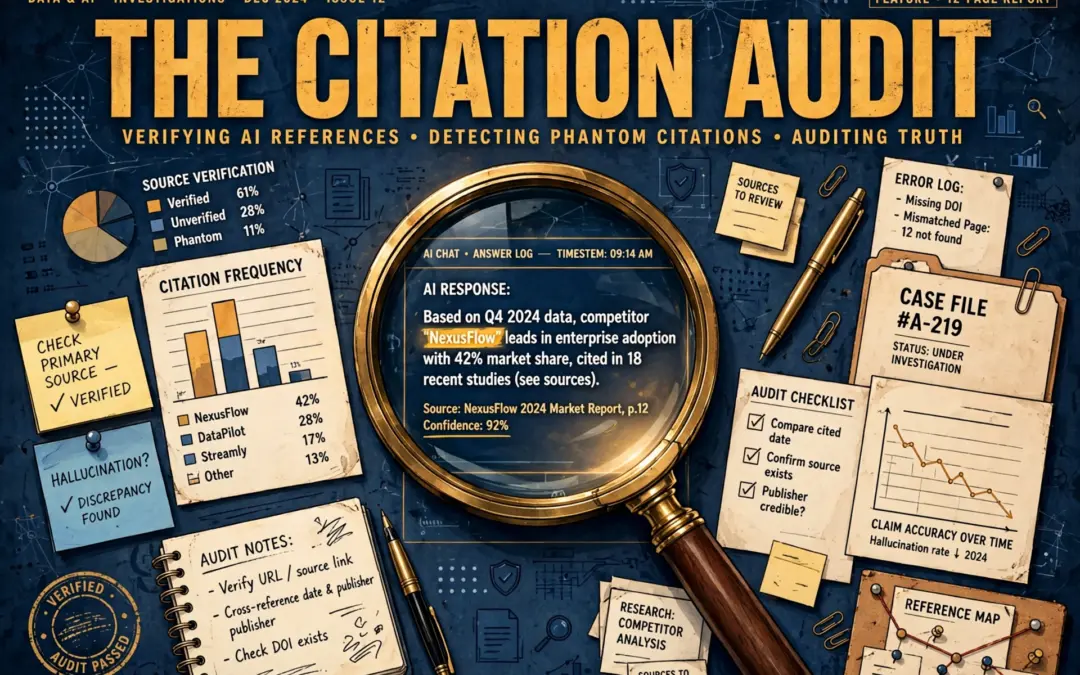
This is the diagnostic follow-up to our field guide, Answer Engines Are the New Search Results: An AEO Field Guide for 2027. That piece covered how the engines pick sources and gave a 10-point audit of your own pages. This one answers the harder question: for the specific queries that make you money, who is actually getting cited — and why is it them and not you? The tool for that is a citation audit, and it takes about an hour a month.
Step One: Build Your Money-Query List
A citation audit starts with a short, honest list — ten to twenty queries, no more. These are not your vanity keywords. They are the questions a ready-to-buy person asks in natural language:
- “What’s the best [product category] for [specific use case]?”
- “[Your product] vs [competitor] — which is better for [audience]?”
- “How much does [service] cost, and who offers it?”
- “What do people recommend for [problem you solve]?”
Write them the way a person talks, because that is how answer engines receive them. Then add your brand queries separately — “[your brand] reviews,” “[your brand] pricing” — because being absent from answers about yourself is a different, more urgent problem than being absent from category answers.
Step Two: Ask the Engines, and Record What They Say
Run every query through all three engines — ChatGPT Search, Perplexity, and Google’s AI Overviews — and log four things per answer: which brands are named, which sources are cited, whether you appear at all, and what the engine says about you if you do. A simple spreadsheet with one row per query per engine is enough. Do it logged out where you can, and repeat each query once, because answers vary between runs; you are looking for the pattern, not a single screenshot.
Two details matter. First, note the position of a mention: the first product named in an answer gets a disproportionate share of the clicks and the trust. Second, read the claims. Engines sometimes describe a competitor’s pricing, features, or positioning more accurately — and more flatteringly — than yours. That is not an SEO problem. That is a source-material problem, and it is fixable.
In answer engines, you don’t have a ranking problem until you’ve checked. You have a citation problem — and citations can be diagnosed.
The Five Usual Reasons Your Competitor Gets Cited Instead
When you line up a month of results, the same five causes explain almost every gap.
1. Their entity is clearer than yours
Engines recommend things they can confidently identify. If your brand name, category, and offering are stated inconsistently across your site, your profiles, and the directories that mention you, the engine hedges — and recommends the competitor it can describe in one clean sentence. Your homepage should let a machine answer three questions instantly: who you are, what you sell, and who it is for.
2. Their pages are structured as answers
Competitors who get cited tend to have pages that state a direct answer near the top, then support it — clear headings phrased as questions, short declarative paragraphs, comparison tables, and FAQ sections. Engines lift what they can quote. A beautiful brand essay with the answer buried in paragraph nine is, to an answer engine, a page with no answer on it.
3. Third parties talk about them more
Citations compound: engines lean on reviews, roundups, comparison sites, forums, and press mentions to decide who is worth naming. If the independent web barely mentions you, the engine has little corroboration to work with. This is the slowest gap to close and the most durable once closed — every genuine third-party mention is a standing argument for citing you.
4. Their content is fresher
For anything with prices, versions, or dates, engines favor sources that look current. A competitor whose comparison page was updated last month will beat your technically superior page from two years ago. Stale pages do not just rank lower; they get quietly dropped from the answer’s source list.
5. They show up where reviews live
For product and service queries, review presence is a citation signal in its own right. Engines read rating platforms and review roundups as evidence of real-world usage. A competitor with a thick, recent review footprint reads as established; a competitor with none reads as a rumor — and engines do not recommend rumors.
Step Three: Make It a Monthly Habit, Not a One-Time Panic
A single audit is a snapshot; the value is in the trend. Run the same query list, in the same engines, on the same week each month, and track three numbers: your citation rate (the share of answers that cite or name you), your first-mention rate, and your share of answer versus your top two competitors. Then work the gaps in order of the five causes above — entity clarity and page structure are usually fixable in a week; third-party mentions and reviews are a quarter’s project.
Expect movement to be uneven. An engine may pick you up for one query cluster months before another. That is normal, and it is exactly why the monthly log matters: without it, you cannot tell a strategy that is working slowly from one that is not working at all. We looked at the mechanics behind these source choices in Perplexity Can Put a Team of AI Agents on One Task — the short version is that engines reward sources that make their job easy. The citation audit simply shows you, query by query, whose job is currently easier: yours or your competitor’s.
Go Deeper: The AI Search Visibility Workbook
If you want the audit as a ready-to-run system — query-list templates, a citation-tracking sheet, and the fix checklists for all five causes — that is exactly what the AI Search Visibility Workbook ($29) was built for: get it on Gumroad. And this weekend it is effectively on sale: code BLKFRIDAY7 takes 40% off through Monday Nov 30, 2026, 11:59 PM ET. Run your first citation audit this week, while the answers your buyers are reading still have your competitor’s name in them.