Answer Engines Are the New Search Results: An AEO Field Guide for 2027
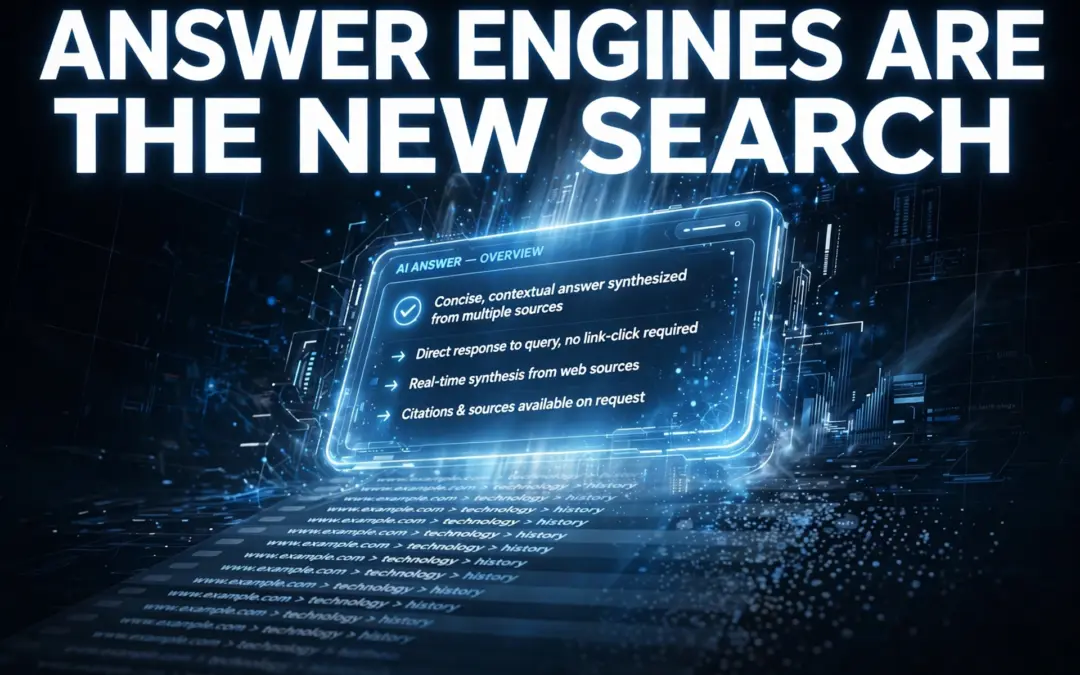
Ask a question in 2027 and watch what happens. You don’t get ten blue links anymore. You get an answer — written in full sentences, with your follow-up already anticipated — and, if you’re lucky, your site is one of the three or four sources cited underneath it. Everyone else who “ranked” for that query is invisible.
That is the shift this field guide is about. We covered the concepts in our earlier explainer on GEO & AEO and the new frontier of search. This piece is the operational follow-up: how the three answer engines that matter — ChatGPT Search, Perplexity, and Google’s AI Overviews — actually choose their sources, what genuinely changes versus classic SEO, and a 10-point audit you can run on your own site this week.
You no longer rank for the answer. You either are the answer’s source, or you’re the research it read and forgot.
How Each Engine Picks Its Sources
All three engines run a version of the same pipeline: retrieve candidate pages, extract the passages that bear on the question, then ground the generated answer in a shortlist of those passages. The differences are in what each one trusts.
ChatGPT Search leans on a search index partnership model and heavily rewards pages that state facts plainly enough to be quoted verbatim. It favors sources it can attribute cleanly — a named author, a dated page, a claim stated in one sentence rather than buried in a paragraph of throat-clearing. If your key fact takes four sentences to reach, the model will find a competitor who said it in one.
Perplexity behaves most like a research assistant with a citation habit. It retrieves broadly, cites aggressively, and tends to surface pages with clear structure: descriptive headings, short definitional paragraphs, lists it can lift without distortion. Community and forum content shows up often in its answers, which means your brand’s presence in genuine discussions matters more here than on any other engine.
Google AI Overviews start from Google’s own index and ranking systems, then apply what Google calls query fan-out — one question is expanded into many related sub-queries, and sources are gathered for each. The practical consequence: a page can be cited for a sub-question it answers precisely, even if it would never rank for the head query. Google Search Central documentation remains the baseline here — if your technical SEO is broken, AI Overviews never even see you.
Three mechanics cut across all of them:
- Retrieval before ranking. Your page must first be fetched and chunked into passages. Walls of unstructured text chunk badly; headed, modular content chunks well.
- Corroboration. A fact stated on several independent, credible sites is safer for an engine to repeat than a fact stated only by you. Engines trust consensus.
- Extractability. The winning passage is usually the one that answers the question completely in 40–60 words, with the entity and the number named explicitly.
What Actually Changes vs. Classic SEO
Plenty of classic SEO survives — crawlability, speed, topical depth, real expertise. Our GEO vs. SEO comparison covers the overlap. Four things genuinely change:
- Cite-worthy facts beat keyword coverage. A page with one original, specific, checkable claim — the kind of first-party data only you have — gives an engine something it cannot get elsewhere. Generic summaries of what everyone already says give it nothing.
- Entity consistency becomes a ranking factor. Engines build a picture of who you are from your site, your profiles, your structured data, and third-party mentions. If your company is described three different ways in three places, the model’s confidence drops. Consistent naming, consistent descriptions, and Schema.org markup that matches your visible text are now citation infrastructure, not decoration.
- Content gets shaped like questions. Real users ask full questions, and engines retrieve passages that match question-shaped intent. Pages organized around the actual questions buyers ask — with the direct answer in the first lines under each heading — map cleanly onto how answers get assembled.
- Freshness is a signal, not a nicety. For anything time-sensitive, engines prefer recently updated sources and show it. A visible “last updated” date, refreshed statistics, and retired stale claims all raise the odds your passage is the one quoted today rather than the 2023 version of you.
The 10-Point AEO Audit (Run It This Week)
Score each item pass/fail. Anything below 7 of 10 means answer engines are citing your competitors for questions you should own.
- Ask the engines directly. Put your 10 most valuable buyer questions into ChatGPT Search, Perplexity, and AI Overviews. Note who gets cited. This is your baseline — everything else on this list exists to change it.
- Check AI crawler access. Confirm your robots.txt and CDN settings aren’t blocking the crawlers these engines use to fetch pages. Blocked retrieval means zero citations, full stop.
- Find your extractable answers. For each money page, is the core answer stated in one tight paragraph near the top? If a human skimming for 10 seconds can’t find it, neither can a model.
- Audit entity consistency. Compare your homepage description, your About page, your LinkedIn/company profiles, and your structured data. Same name, same category, same claims — everywhere.
- Validate your structured data. Organization, author, and FAQ/HowTo markup where it honestly applies — and make sure the markup matches what’s visible on the page.
- Hunt for orphan facts. List the claims only your company makes. Now check: are they stated plainly on your site, in citable form, with a date and a source (you)? Original data unpublished is original data wasted.
- Fix question coverage. Pull real questions from sales calls, support tickets, and search console queries. Every recurring one deserves a page section that answers it head-on.
- Refresh or retire stale pages. Update statistics, add current dates, and merge or remove thin pages that contradict your newer positions. Engines notice disagreement inside your own site.
- Build corroboration. Get your key facts repeated by independent sources — guest posts, interviews, directory listings, partner pages. Consensus is what lets an engine repeat your claim with confidence.
- Measure citations, not just clicks. Track how often you’re cited per engine, per question set, monthly. We laid out the measurement approach in our guide to measuring SEO and AI visibility ROI — citations are now a first-class metric alongside rankings.
The Bottom Line for 2027
Classic SEO asked: can Google find and rank this page? AEO asks a harder question: would a machine stake its answer on this page? The sites winning citations in 2027 are not the ones with the most content. They’re the ones with the clearest facts, the most consistent entity story, and pages built to be quoted. Run the audit, fix the failures in order, and re-check the engines in 30 days. The answer box is the new results page — and it’s already deciding who gets found.