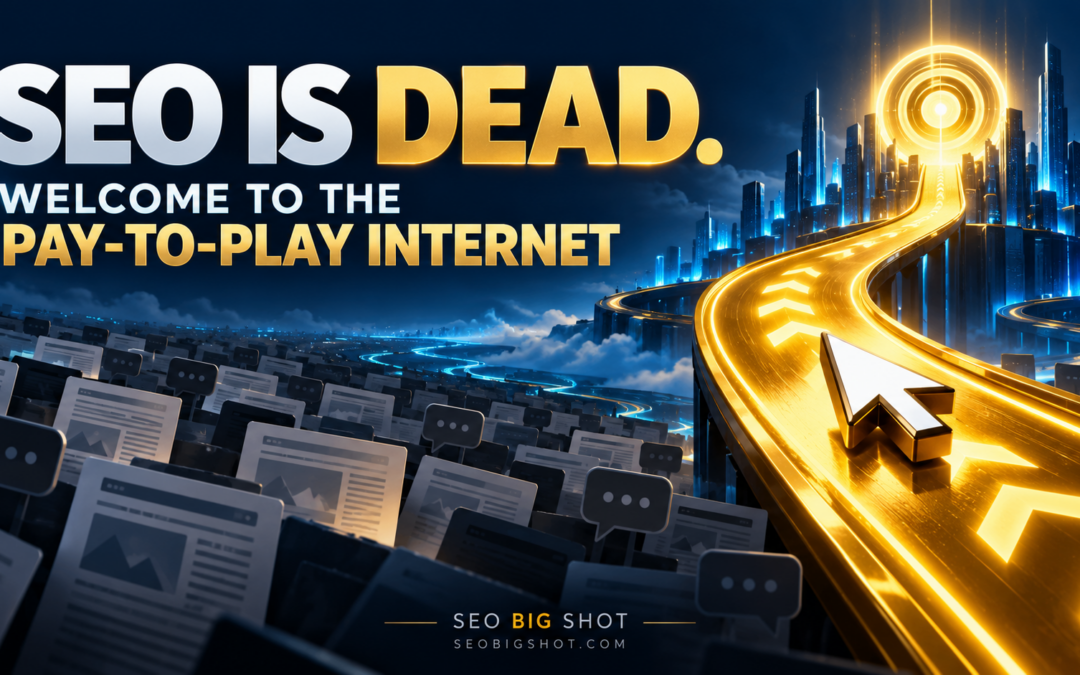
SEO Is Dead. Welcome to the Pay-to-Play Internet
Small businesses were told that great content and consistent posting could beat big budgets. That promise deserves a serious reality check.
Write more blog posts. Optimize your keywords. Post every day. Make videos. Build your audience. Be patient.
For years, small business owners have heard the same instructions: keep feeding the internet, and eventually the internet will feed your business.
Meanwhile, the bills arrive on schedule. The customers do not.
A competitor appears in a sponsored placement. A national brand captures attention before someone reaches your website. Your latest social post gets a handful of likes, and your carefully researched article attracts visitors who never buy anything.
At some point, an owner has to ask:
Am I building a customer acquisition system, or am I working for free to keep these platforms interesting?
My argument is simple: the version of SEO sold as an affordable, dependable path to business growth is dead for many small businesses.
Organic marketing still produces winners. But building a business around the expectation of free visibility has become a dangerous bet.
The old saying has followed us online:
You need money to make money.
The Biggest Myth in Marketing: “Organic” Means Free
A business owner spends ten hours writing articles, editing videos, creating graphics, and scheduling posts.
The advertising bill is zero.
The marketing cost is not.
If those ten hours are worth $75 each, the business has invested $750 before paying for software, contractors, or website maintenance.
That investment might produce valuable customers. It might produce nothing.
Yet owners routinely scrutinize a $500 advertising budget while accepting months of unpaid content production without asking what it earns.
That is backwards.
A marketing activity does not become economical simply because the platform never sends an invoice.
Time has a cost. Delayed sales have a cost. Spending six months pursuing the wrong audience has a cost.
“Free marketing” can become one of the most expensive habits a small business develops.
Even Getting Found Does Not Guarantee a Visit
Traditional SEO rests on a familiar chain of events:
Someone searches. Your page appears. They click. Your website gets an opportunity to convert them.
But that chain can break before the click.
In a July 2025 analysis, Pew Research Center examined browsing data from 900 U.S. adults. Users clicked a traditional search result in 8% of visits when an AI summary appeared, compared with 15% when one did not. Links inside the summaries received clicks in just 1% of visits with a summary. Source: Pew Research Center
Those findings describe a particular study period, not every industry or a guaranteed outcome for your website. They also do not establish that AI summaries alone caused the difference.
But they expose a serious weakness in the old content strategy.
Your business can publish the answer someone needs—and the search experience can satisfy that person without delivering a visit.
For an owner paying to produce that content, being useful and being commercially rewarded are two different things.
Big Businesses Can Afford to Keep Buying Opportunities
Why do major brands seem to be everywhere?
They can fund repeated exposure, run campaigns across channels, hire specialists, and keep testing when the first attempt disappoints.
A small business might have enough money for one campaign. A larger competitor may have enough money for twenty experiments and the staff to learn from them.
That creates an advantage beyond advertising volume.
It creates more chances to discover what works.
Large businesses can also sometimes justify higher acquisition costs because they have repeat purchases, broader product lines, or stronger margins. A competitor may be willing to lose money on the first transaction because it expects to earn more later.
The small operator bidding against that business is competing against its economics as well as its advertising budget.
Money does not guarantee victory. Google’s own documentation explains that ad placement depends on several factors, including bids, ad and landing-page quality, search context, and competition. The highest spender does not automatically win every auction. Source: Google Ads
Still, a business needs enough resources to enter, test, learn, and continue.
That is where limited budgets hurt.
Posting More Is Not a Business Model
A restaurant does not pay its staff with impressions.
A consultant does not cover rent with video views.
An online store cannot deposit engagement into its bank account.
Attention matters when it contributes to a commercial result. But content production can become a self-sustaining routine that nobody evaluates honestly.
The business keeps publishing because publishing feels productive.
The reports show activity:
- More posts.
- More impressions.
- More followers.
- More website sessions.
Then somebody asks how many profitable customers came from all that work.
The room gets quieter.
Some content earns its place by helping prospects trust the business, answering sales objections, or encouraging repeat purchases. Other content fills a calendar.
A busy publishing schedule can hide an empty sales pipeline.
Pay to Play Means Buying a Measurable Opportunity
Paid advertising offers something an organic-only strategy often struggles to provide: a deliberate way to put an offer in front of a selected audience and evaluate the response.
Search advertising can target commercial intent. Paid social can introduce a product to relevant audiences. Paid distribution can give a useful video a defined test instead of leaving its entire future to discovery.
None of that guarantees sales.
But it creates a practical business question:
Can we acquire a customer for less than the value that customer contributes?
That question is more useful than asking whether a post performed better than last Tuesday’s.
It also changes the work.
The priority becomes choosing the right audience, making a compelling offer, building a persuasive landing page, and measuring what happens after the click.
Target Buyers, Not Just Keywords
There is a substantial difference between someone researching a subject and someone preparing to purchase.
Consider a tennis business.
A search for “how to improve your forehand” could come from almost anyone, anywhere.
A search for “private tennis lessons Delray Beach” is much closer to a local buying decision.
Both audiences can have value. They should not automatically receive the same investment.
With limited resources, a small business needs to focus on the searches and audiences most closely connected to its offer.
That means asking:
- Does this person need what we sell?
- Can we serve their location?
- Does the search suggest buying intent?
- Is the likely sale valuable enough to support the acquisition cost?
- Does our landing page deliver exactly what the advertisement promises?
A popular keyword can be a terrible investment. A narrow keyword with modest volume can be commercially useful.
The goal is to reach enough suitable buyers at a workable cost.
Conversion Rate Is Where the Economics Change
Buying traffic without improving the website can become an efficient way to waste money.
Consider this hypothetical campaign:
| Metric | Initial landing page | Improved landing page | Advertising spend | $1,000 | $1,000 | Average cost per click | $5 | $5 | Visitors | 200 | 200 | Visitor-to-lead conversion rate | 2% | 5% | Leads | 4 | 10 | Advertising cost per lead | $250 | $100 |
|---|
The advertising spend stays the same. The number of leads changes substantially.
Now assume 20% of leads become customers over a sufficiently large sample. The implied advertising cost per customer falls from $1,250 to $500.
Whether either result is profitable depends on margins, fulfillment costs, customer retention, and other expenses.
But the lesson is clear: the page receiving the traffic can matter as much as the campaign delivering it.
A stronger headline, clearer pricing, credible testimonials, faster mobile experience, easier booking process, or better offer may change the economics.
Before buying more visitors, make sure the existing visitors have a compelling reason to act.
Stop Reporting Clicks. Start Following the Money.
A useful marketing dashboard connects spending to business outcomes.
Track advertising cost, qualified leads, booked appointments, completed sales, acquisition cost, and contribution profit after relevant costs.
For a service business, distinguish a submitted form from a suitable prospect. For an online store, account for returns and discounts. For a subscription business, examine retention rather than assuming every new customer stays indefinitely.
Platform reports are useful, but reconcile them with actual sales records. Different platforms can claim credit for the same purchase.
Also ask whether the campaign generated new demand or captured customers who were already coming to you. A profitable-looking branded search campaign does not automatically prove that every reported sale was incremental.
Good analytics should improve spending decisions, not decorate a presentation.
Small Businesses Need a Smaller Battlefield
A small business trying to compete everywhere is likely to spread its budget and attention too thin.
It needs a specific customer, a specific problem, a defined market, and an offer it can deliver profitably.
For an initial paid test, that might mean one service, one geographic area, one focused landing page, and a limited group of relevant searches.
Set a test budget the business can afford to lose. Define what constitutes a qualified lead. Decide what results would justify continuing, changing direction, or stopping.
A tiny budget may not generate enough evidence in an expensive market. A larger budget will not rescue weak economics.
If advertising cannot acquire customers profitably, the answer may involve changing the offer, improving conversion, increasing retention, or choosing another acquisition channel.
“Pay to play” is an argument for disciplined investment. It is not permission to keep spending until the bank account gives up.
What Happens to Blogging, Videos, and Social Media?
Give them a commercial job.
A video can demonstrate a product. A case study can help close a prospect. An article can answer a question that repeatedly delays a sale. A social profile can reassure someone who has just discovered the business through an advertisement.
Keep producing content that earns attention, builds trust, supports sales, or retains customers.
Reduce the rest.
Organic search, referrals, local discovery, partnerships, and established audiences can still generate meaningful business. Declaring every unpaid channel useless would ignore real results.
But the possibility of organic success should not excuse an endless content treadmill with no evidence of return.
A blog post needs a purpose beyond being another blog post.
You Need Money to Make Money—and a System That Makes It Count
The internet was supposed to give the smallest business a chance to compete.
That opportunity still exists. The mistake is assuming participation guarantees distribution, or that distribution guarantees customers.
For many small businesses, the sensible starting point is a funded acquisition plan: a focused offer, targeted advertising, a page that converts, reliable follow-up, and analytics that connect spending to profit.
SEO can support that system. Content can strengthen it. Social media can help people trust it.
But “keep posting and hope” deserves to be retired.
If SEO is dead, it is the old promise that enough optimization and persistence will reliably overcome limited resources and powerful competitors.
Business owners deserve a more honest conversation about what growth costs.
You need money to make money.
And you need to know whether the money you spend is actually bringing any back.
Stop Chasing Rankings. Start Building a Plan to Win Customers.
 Your business needs more than another blog post, a prettier traffic report, or a promise to “give SEO more time.”
It needs a clear answer to one question: What turns your marketing investment into paying customers?
That means connecting targeted visibility with compelling offers, persuasive landing pages, conversion tracking, and decisions based on actual sales.
Ready to take a harder look at what your marketing is delivering? Make SEO Bigshot your next stop. Bring your goals, your challenges, and the question every business owner should be asking: Where should my next marketing dollar go?
You work too hard for your money to spend it chasing attention without a plan to turn it into business.